Classes at Tyagi Algorithm Design Bureau
Serious data structures & algorithms training, in Bhopal.
Get interview ready for the world’s highest paying jobs. Now taking students in both online and offline batches, taught by Abhinav Tyagi. Students across the country may enroll in the online class.
TyD 75 — an industry-relevant update on Blind 75, rebuilt around what is actually asked now. Trees · Graphs · Heaps · Backtracking · Dynamic programming
TyD’s systems and approach are an industry first: two months of training aimed squarely at performing in coding interviews and on the job, at firms like Google, Meta, Amazon and Netflix.
In person at RKY Tower, Hoshangabad Road, or live online from anywhere in India, 5 days a week. Develop the grit of a seasoned programmer, express deep logic to build efficient and performant systems, with techniques created by the brightest minds.
Batch sizes are capped at 15, for personal attention — the method depends on the instructor seeing every screen.
Taught live by Abhinav Tyagi, with a hyper-customised platform targeted at turning you into a DSA professional and tracking your performance, as part of your training package.
The hiring bar
Algorithms are how engineers are hired.
What these roles pay in India — not an overseas package converted at today’s rate.
SWE interviews routinely featuring strings problems.
A full algorithmic interview, of the kind these sixty days are built around.
Not a consumer-internet company at all — silicon. The same interview. Median for the level in India, levels.fyi, September 2026.
In contrast to an over-supplied IT services market hiring in bulk below ₹6 LPA, roles filled by engineers who can actually write the code start at no less than ₹10 – 15 LPA. Some domestic examples:
| Strong product firms and capability centres | ₹18 – 35 LPA |
| Microsoft, SDE-1, India | ₹25 – 35 LPA |
| Amazon, SDE-1, India | ₹26 – 42 LPA |
| Google, L3, India | ₹45 – 80 LPA |
| Meta, E3, India | ₹50 – 70 LPA |
All of this, and a great deal more, opens up to someone who has honed data structures and algorithms.
Every figure above is for a job in India. Estimates from public salary data, 2026. We do not quote an overseas offer and call it a local result. Small and mid-size product firms, starved of people who can actually write the code, routinely clear ₹30 LPA on the same test.
Hiring on it now
Google · Meta · Amazon · Microsoft · Netflix · Autodesk · Genesys · Atlassian · Uber · Rubrik · DE Shaw · Sprinklr · Zoho · Zerodha · Postman · Razorpay · Navi · Walmart Global Tech · Goldman Sachs — and a long tail of firms you have never heard of, paying the same.
The platform
TyD DSA training & performance tracking platform
A portal built for this course: a sparse editor, a judge, a recall ladder, and a mark whose working you can see.
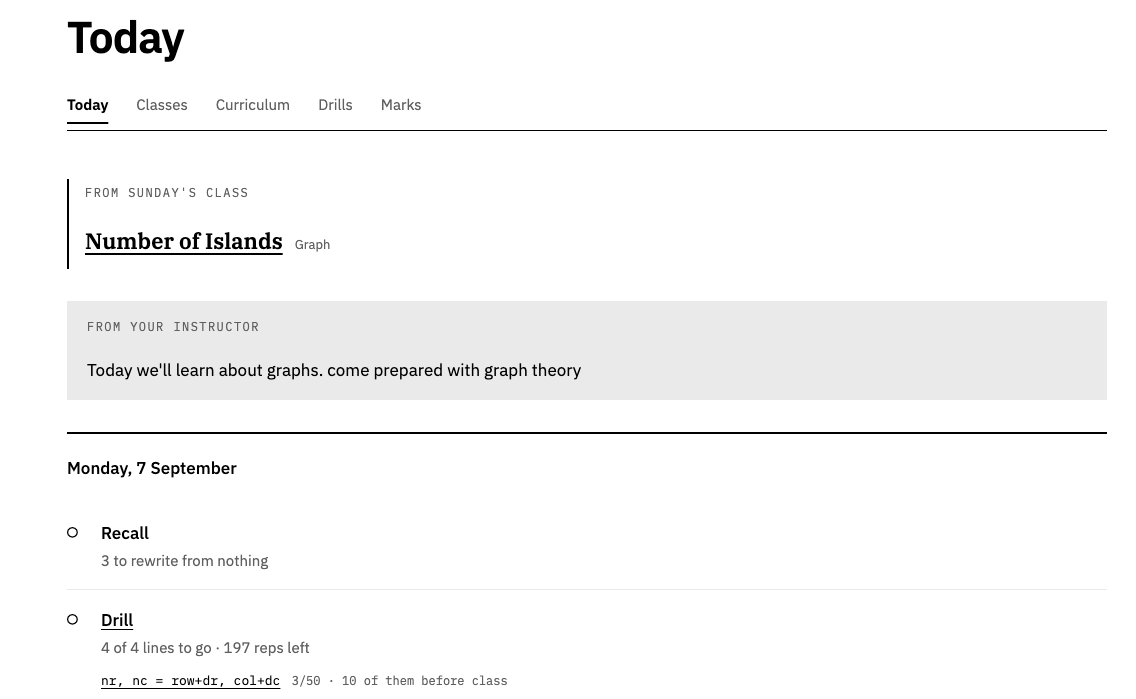
Swipe to read the screen →
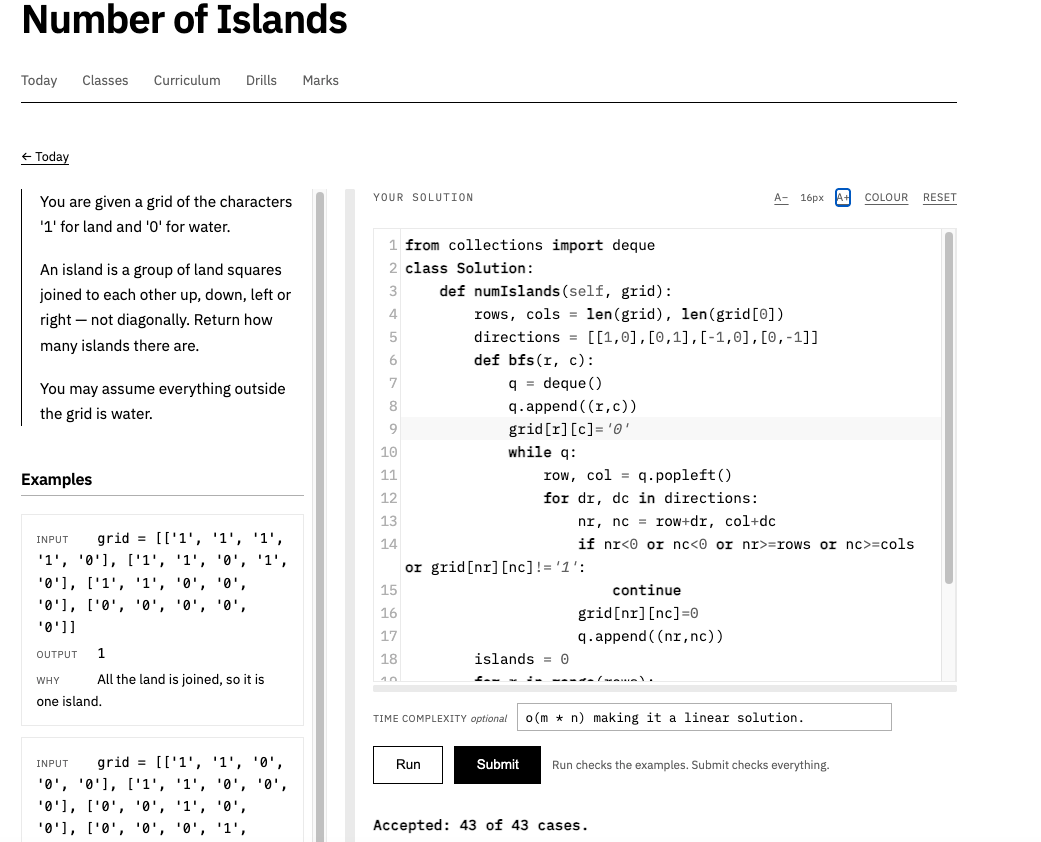
Swipe to read the screen →
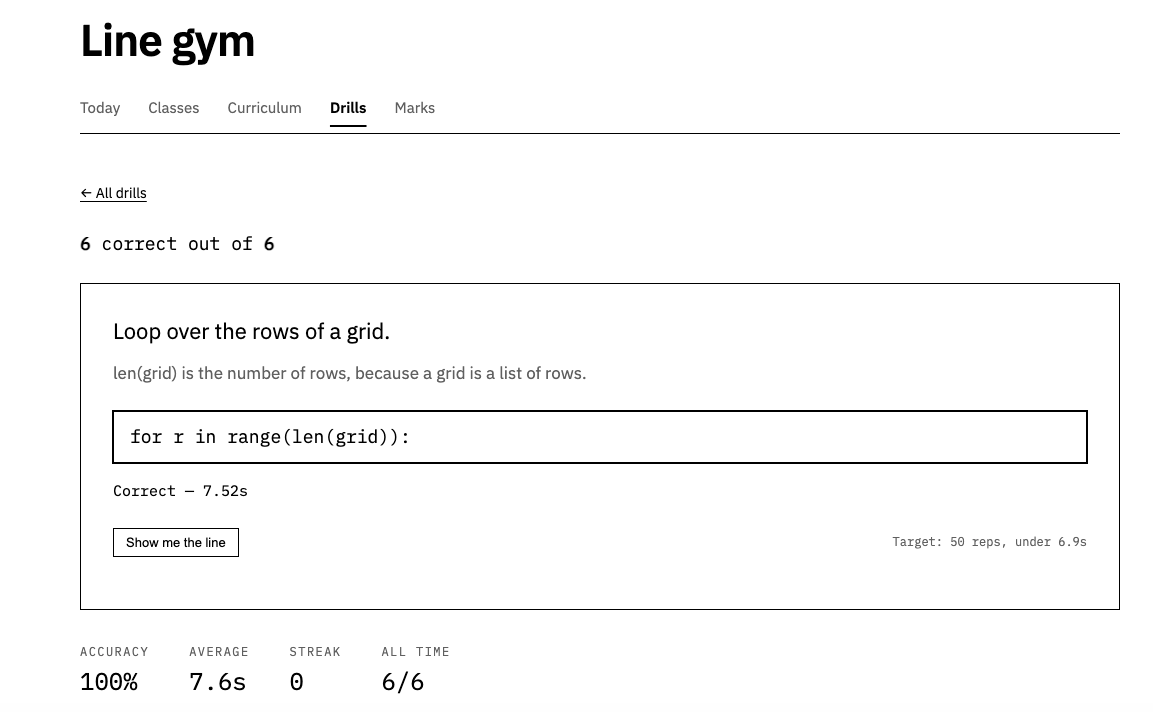
Swipe to read the screen →
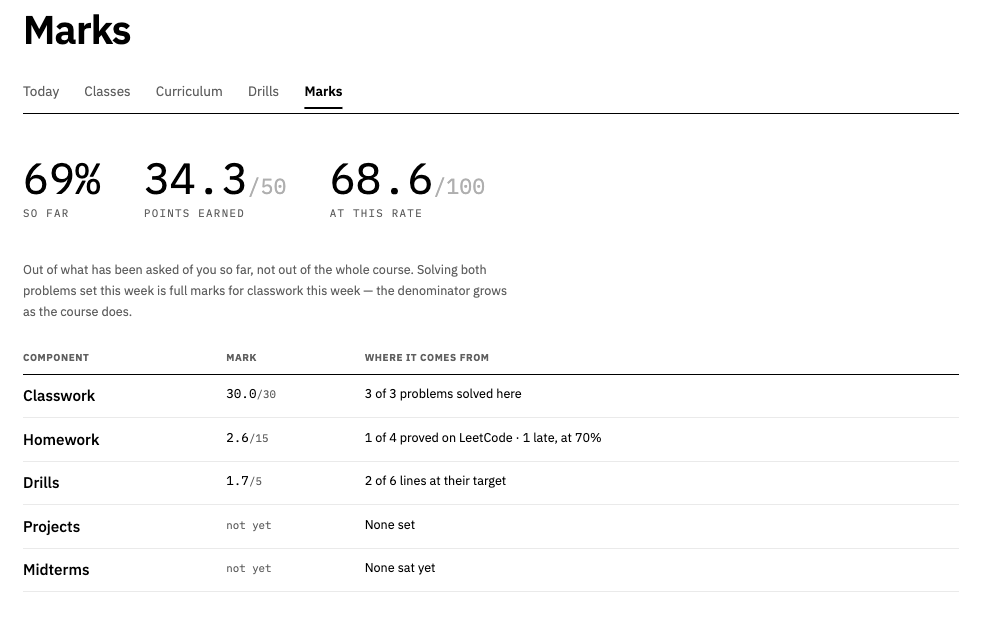
Swipe to read the screen →
The platform as it stands, September 2026, signed in as a demonstration student. The figures are that account’s, not a real one’s.
| Live class | During class the instructor watches every student’s editor as they type — in the room or online — sees who is stuck first, and points to the line. He never types into it: the code stays yours. |
| Practice | Full statement, examples, sparse editor, Run and Submit. The same sequence as a real interview. No autocomplete. |
| The judge | Your solution runs in a locked-down container against generated tests, compared with a reference. Accepted or not. No “I basically had it.” |
| Recall | Taught problems return after 1, 4, 14 and 35 days, from a blank editor. The difference between having solved 77 problems and being able to solve them in March. |
| Drills | Line gym and indentation trainer, assigned from what the batch was taught that day. Syntax must not cost working memory. |
| Homework | The same problem on LeetCode, Accepted — and we ask LeetCode ourselves rather than taking a picture of it. The public profile is the asset that outlives the course. |
| Classes | Every session kept: what was taught, the note, and whether you submitted, drilled, and proved it. |
| Curriculum | All 77, with what has been covered marked off. A problem still to come is not a link — running ahead of the class is not the method. |
| Marks | Classwork 30, homework 15, drills 5, two projects, two exams. Nothing counts against you before it has been asked. |
Your instructor
Abhinav Tyagi

Hi, prospective student. Thank you for your inquisitiveness in scrolling down this far.
I built this platform for you, the future software engineer, to expose your mind to real engineering constraints, to mathematical problem solving, and to how both are applied in industry and research.
The platform has supplemental features that substantially aid and speed up learning. I hand-picked the most relevant concepts and problems for this coursework, aligned closely with what the industry demands now. The updated Blind 75 list is called TyD 75.
It is a pleasure to offer my services to build the next generation of coders, programmers, mathematicians and engineers.
The whole of it is yours for the taking. I look forward to seeing you in the class.
Best of luck.
— Abhinav Tyagi
Consequence
Algorithms that run the world.
Perceived sanity is complexity abstracted away by efficient algorithms written by Software engineers and mathematicians, that govern:
- Avionics on passenger and fighter aircraft
- Surgical devices and robots
- Nuclear plant control
- Disaster and grid systems
- Space, launch, and satellites
- Energy systems
- Operating systems
- Video games and simulation
Fault tolerant algorithms that have been executing for years to maintain modern society functioning and monitored against disaster.
The advent of AI has only deepened the demand for engineers that can code and write effective algorithms.
This course will be one your best investments to turn yourself in to one of those engineers.
Alan Turing Vs Hitler’s Enigma Machine: The Original DSA Problem
The real story of world war 2 was the Bombe machine that broke critical Nazi communication lines encrypted using the engima machine, hiding the message behind one of the 1.58 × 10²⁰ combinations (159 quintillion), making the brute force attack impossible.
By heavily restricting the search space, turing’s algorithm reduced the search space by a factor of 151 trillion, making the code searchable in 20 minutes using the bombe machine.
This therefore, can be considered the original DSA problem. Immense fire power of axis forces ultimately lost out to mathematicians and computers.
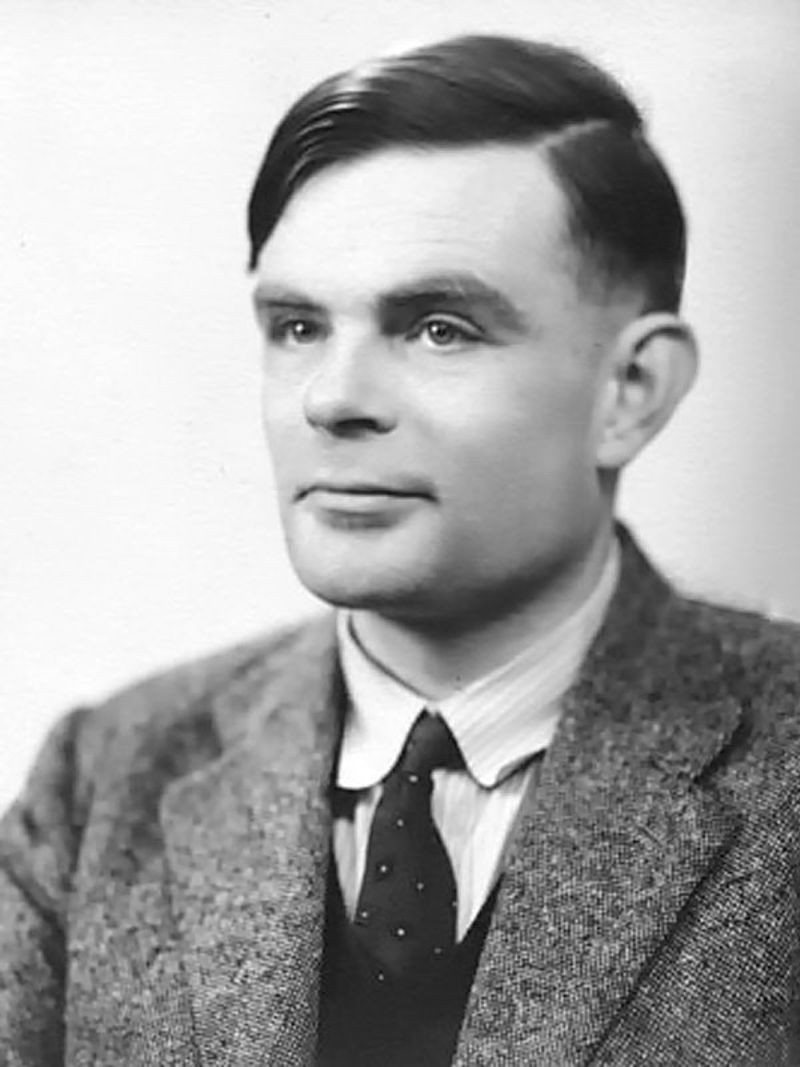
Alan Turing · 1912–1954 · photographed 1951 by Elliott & Fry · public domain


US Army photograph · public domain
The original 6 programmers (not depicted here) Kay McNulty · Betty Jean Jennings · Betty Snyder · Marlyn Wescoff · Frances Bilas · Ruth Lichterman
1945 Bomb Trajectories, ENIAC & its 6 Original Programmers.
Reducing time required to calculate a artillary gun trajectory by 2,400 times to just 30 seconds from several hours, these 6 mathematicians were the original programmers of the ENIAC, the first general-purpose electronic computer ever made, which also played a pivotal role in running massive mathematical models to test the feasibility of a thermonuclear bomb.
The other side of the planet
Radar, and deciding what to do about what it sees
Meanwhile, on the other side of the planet, the other super power was trying to build its own superior weaponry that used computer systems actively for attack decisions and operating precision weaponry.
The MiG-29 carried the N-019 pulse-Doppler radar, an infrared search-and-track set, a laser rangefinder and a radar warning receiver — and a computer whose job was to reconcile them into one picture and rank what mattered. Pulse-Doppler works by filtering: separating a moving aircraft from the enormous return of the ground beneath it. The fire-control computer tracked targets while still scanning, and chose which of the R-27R, R-73 or R-60M to release from the six pylons.
A project to power a radar system on such aircraft is included in our curriculum.
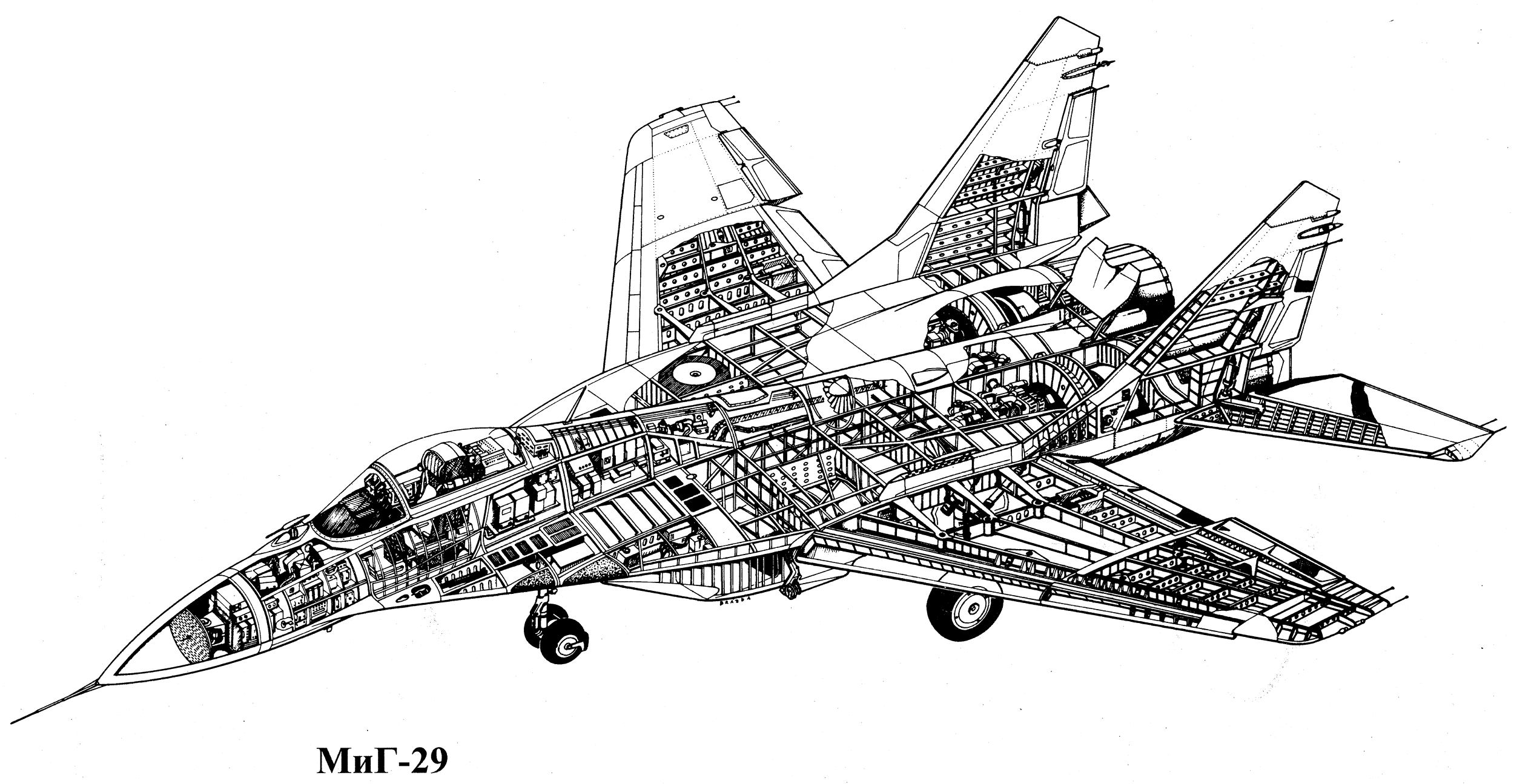
Swipe to follow the drawing →
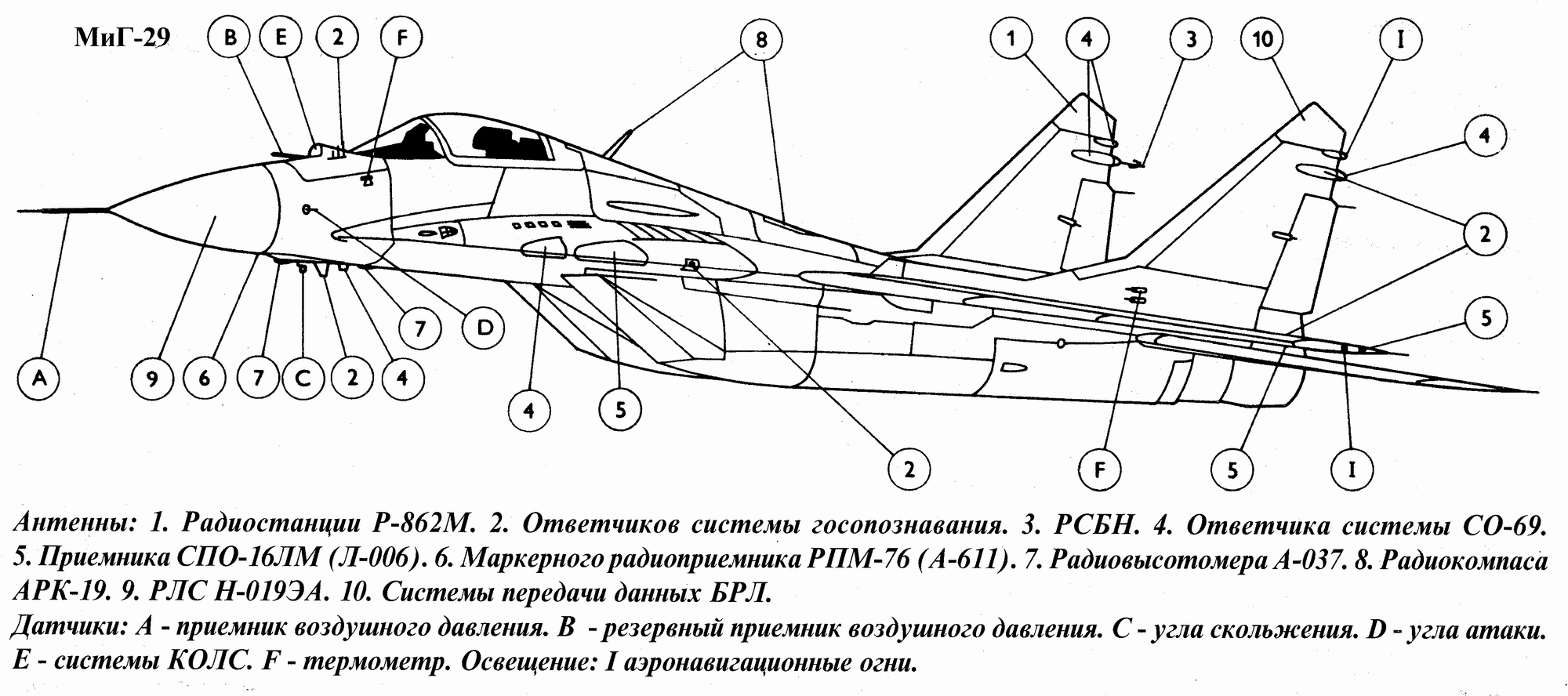
Swipe to follow the drawing →
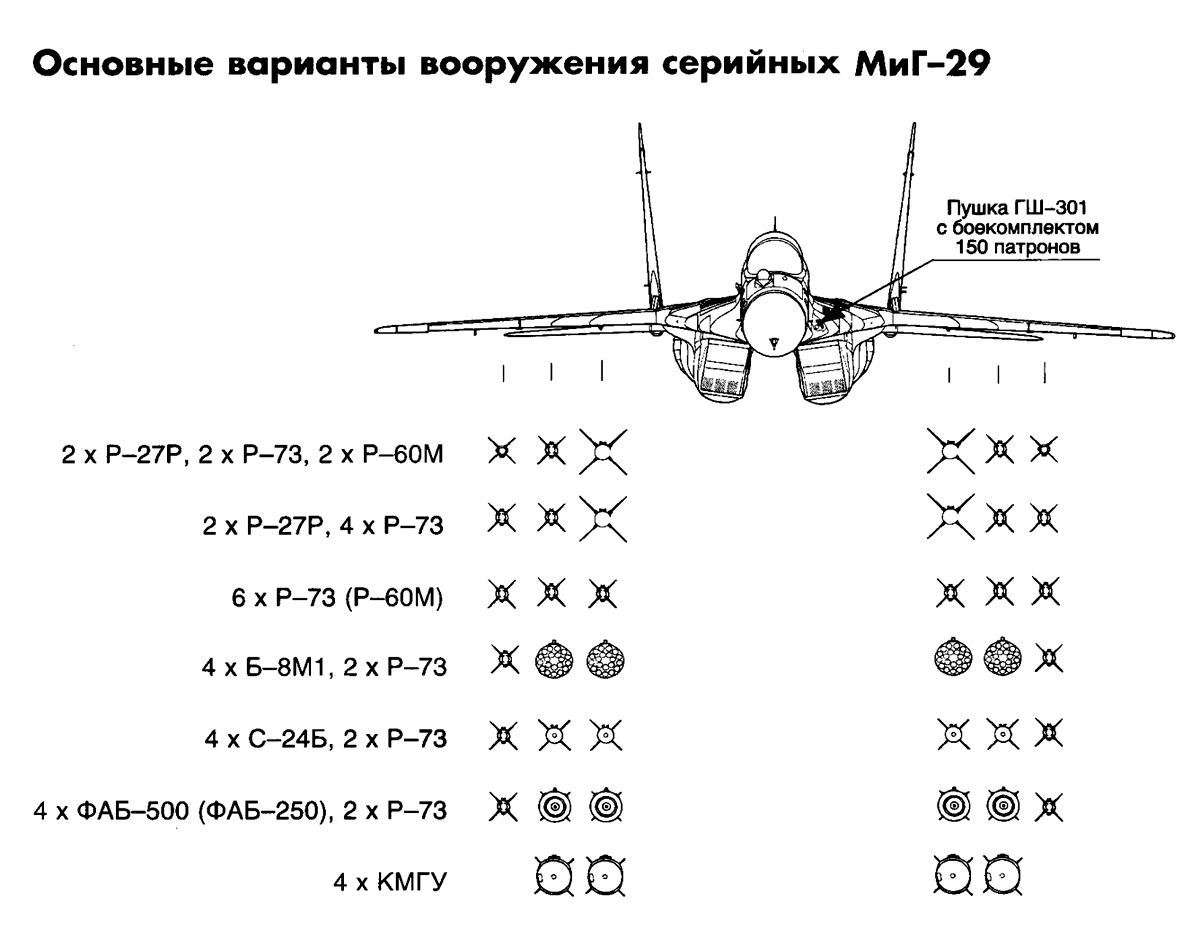
Swipe to follow the drawing →
Somebody writes it. That person once sat where you are sitting.
The method
Training aligned with the expectations of the interview
Each problem is taught as if the interviewer is in the room. Everything below is what that room grades.
What an interviewer scores you on
- Understanding the problem and its constraints
- Verbally communicating the thought process while coding
- Several solutions, ranked by trade-off — mainly space and time complexity
- Arriving at an acceptable solution through conversation
- Writing the code cleanly, from scratch, with no assist, in a basic text editor
- Taking the interviewer's hint and incorporating it
- Checking the code by dry-running it, and catching the errors
Apart from being an excellent programmer, the ability to talk to the interviewer and to catch your own errors while dry-running are weighed very heavily in your favour.
This programme puts you in front of exactly that, over and over, for two months — which is where the competitive advantage comes from.
What you do every day, until it is second nature
-
Explain the problem statement after reading it
Before writing any code, it is imperative that you understand the problem. You say it back, in your own words, out loud.
-
Clarify the constraints
A solution has to satisfy the constraints, and gathering them is the engineer's job rather than the question-setter's — a trait rewarded as heavily at work as it is in the room.
-
Propose solutions, and identify the one that fits
There is always more than one way. Through the problem statement and a space-and-time analysis you learn to arrive at the solution the interviewer is actually waiting for.
-
Write clean, readable code with no assist
Everything else is forgivable if you can do this. The language should be your mother tongue: loops, functions and conditions written as if you had done it a million times. The drill system exists for exactly this — primitive lines, every day, until they are permanent.
The method is universally applicable, and the editor takes Python. What is taught here — the structures, the complexity arguments, the way an approach is defended aloud — carries into any language you are later paid to write. The judge on this platform accepts Python only.
That is not a limitation to work around. Python is generally at an advantage in an interview: it is concise, so there is less to type and less to get wrong under a clock, and more of the hour is spent on the problem rather than on the ceremony around it.
The syllabus
Topic-wise coverage
The list below is the whole of it, with the number of problems allotted to each topic — including detailed space and time complexity, and the trade-off analysis. Topics are revisited across separated dates rather than finished and abandoned.
- Tree 14
- Dynamic Programming 12
- Arrays 10
- String 10
- Graph 9
- Linked List 6
- Interval 5
- Matrix 4
- Heap 3
- Backtracking 2
- Binary Search 2
Fees
The programme, in numbers
- 45
- Sessions
- 77
- Problems
- 60
- Days
- 15
- Seats a batch
Two sittings a day, currently at 5:00 pm and 7:00 pm, 5 days a week, with weekends off. Rest is part of the method, not an absence of it.
The programme is ₹9,000 at the
launch offer (₹22,000), payable in full
before classes begin. Sign up and pay, and we call you to agree a batch
time that suits you. Discount codes are issued directly and apply at
checkout.
A full refund is available up to the end of day 3, counting your first class as day one. After that, no refund is available — the seat cannot be resold once teaching has begun. The refunds and cancellation policy sets this out in full.
Seats are limited to 15 per batch, because the method depends on the instructor seeing every screen.
In-person classes are held at S-03, 3rd Floor, RKY Tower, Hoshangabad Road, Bhopal 462026, near Aashima Mall and Surendra Landmark. Get directions. Online batches are taught live, on the same platform, from wherever you are.